Package reference
Reference · Packages
AskDB is a workspace of focused packages. Install the ones your use case needs. This page is the index — purpose, install, and key exports for each.
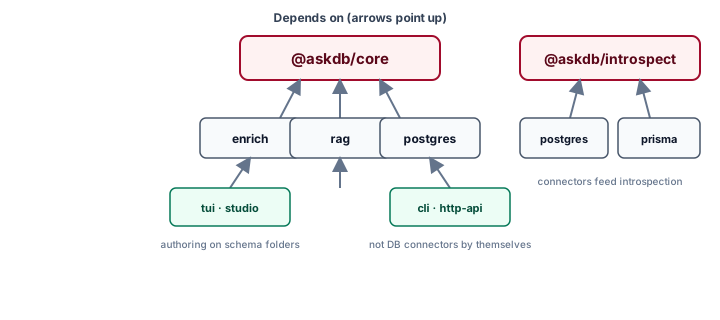
AI provider adapters (@askdb/ai-openai, @askdb/ai-azure, @askdb/ai-google, @askdb/ai-anthropic) plug into the surfaces shown above via @askdb/ai. @askdb/client sits above @askdb/core + @askdb/ai as the config-driven entry point.
@askdb/core
Section titled “@askdb/core”The dialect-agnostic NL-to-SQL pipeline. Schema loading, prompt construction, validation, and tenant-scope handling all live here.
npm install @askdb/coreKey exports
| Symbol | Purpose |
|---|---|
ask(options) | The main pipeline. Returns validated SQL. |
loadSchema(path) | Load a schema artifact from a directory, bundle, or schema.json. |
validateTenantScope / resolveTenantSql | Tenant-scope enforcement primitives. |
createAskDbLogger | Structured logger that emits AskDB log events. |
POSTGRES_DIALECT and built-in dialect IDs | Dialect inputs accepted by ask(). |
AskDbLanguageModel | AskDB’s public name for the AI SDK language model contract. |
@askdb/client
Section titled “@askdb/client”Config-aware facade over @askdb/core. createAskDb() resolves the schema, model, and
dialect from your askdb.config.* (and a provider registry you supply), so call sites pass
only a question. Install it when you want the shortest config-driven path; skip it when you
construct the model and load the schema yourself and call ask() directly.
npm install @askdb/client @askdb/ai @askdb/ai-openai @askdb/configKey exports
| Symbol | Purpose |
|---|---|
createAskDb(options) | Build a client bound to a config + AI registry. Returns { ask, reload }. |
client.ask(question, overrides?) | Resolve schema/model/dialect and run the pipeline. Overrides: schema, model, dialect, plus all ask() options. |
AskDbClient / CreateAskDbOptions / AskOverrides | Types for the client, constructor options, and per-call overrides. |
@askdb/ai
Section titled “@askdb/ai”Optional AI provider registry and shared config helpers. Install this when you want AskDB to
construct AI SDK language or embedding models from askdb.config.* / env maps. Pair it with a
provider adapter package such as @askdb/ai-openai. Skip it when you already construct your own
AI SDK model and pass it to ask().
npm install @askdb/aiKey exports
| Symbol | Purpose |
|---|---|
createAiRegistry | Register provider adapters and build language or embedding models. |
registry.resolveAiConfig(env) / registry.resolveEmbeddingConfig(env) | Resolve provider config from env without constructing a model. These are methods on the registry returned by createAiRegistry, not standalone exports. |
resolveBaseConfig | Low-level helper — resolves a provider’s base config object from an env map. Used internally by adapters. |
withEmbeddingProviderOptions | Wraps embedding provider options; shared across adapters. |
aiKeyMissingMessage | Shared human-readable missing-key guidance. |
Provider adapters
Section titled “Provider adapters”Provider adapters own concrete AI SDK provider dependencies. Each adapter declares ai and @askdb/ai as peer dependencies — npm/pnpm install them automatically, but your app should depend on ai directly when you want to pin the version.
npm install @askdb/ai-openainpm install @askdb/ai-azurenpm install @askdb/ai-googlenpm install @askdb/ai-anthropicAny provider that has a Vercel AI SDK package can be added as an adapter. Unknown ai.provider values require a registered adapter — first-party apps register openai, azure, foundry, google, and anthropic; for anything else, embed AskDB and register your own adapter, or use an OpenAI-compatible endpoint via the openai provider and a custom base URL.
@askdb/connectors
Section titled “@askdb/connectors”Connector provider registry — mirrors the @askdb/ai pattern for introspection. Each engine adapter exports a ConnectorProviderAdapter constant; @askdb/connectors wires them into a unified registry used by the CLI and apps. Install directly only when you are building a custom introspection flow.
npm install @askdb/connectorsKey exports
| Symbol | Purpose |
|---|---|
createConnectorRegistry(adapters) | Build a registry from a set of provider adapters. |
ConnectorRegistry | Registry type — createConnector(provider, config), getTemplates(provider). |
ConnectorProviderAdapter | The adapter shape each engine package exports. |
@askdb/config
Section titled “@askdb/config”Optional config bootstrap: .env and askdb.config.* discovery, type-safe defineConfig, and a runtime snapshot accessor.
npm install @askdb/configKey exports
| Symbol | Purpose |
|---|---|
defineConfig(config) | Type-safe config builder. |
bootstrapAskDbEnv(options) | Load .env + askdb.config.* and install the runtime snapshot. |
getAskDbRuntimeConfig() | Read the runtime snapshot (preferred over process.env). |
discoverAskDbConfigPath() | Programmatic config-file discovery. |
env, requiredEnv | Typed env-var accessors. |
Engine adapters
Section titled “Engine adapters”Each engine package ships the introspection connector for its engine, any catalog SQL templates, and a re-export of that engine’s dialect constant. The dialect specs themselves (SQL generation + validation rules) live in @askdb/core — ask() needs only the dialect id, no engine package.
@askdb/postgres
Section titled “@askdb/postgres”npm install @askdb/postgresPostgreSQL dialect, connector, catalog SQL templates, and an optional pg-based catalog query runner for live introspection. Pass dialect: "postgres" to ask().
@askdb/mysql
Section titled “@askdb/mysql”npm install @askdb/mysqlMySQL dialect and introspection. Pass dialect: "mysql" to ask().
@askdb/sqlite
Section titled “@askdb/sqlite”npm install @askdb/sqliteSQLite dialect and introspection. Works with embedded file-backed databases. Pass dialect: "sqlite" to ask().
@askdb/sqlserver
Section titled “@askdb/sqlserver”npm install @askdb/sqlserverSQL Server (T-SQL) dialect and introspection. Pass dialect: "sqlserver" to ask().
Introspection
Section titled “Introspection”@askdb/introspect
Section titled “@askdb/introspect”The engine-agnostic introspection contract and the schema-directory writer. Use directly only when you’re calling introspection from your own code — the CLI wraps this for you.
npm install @askdb/introspect@askdb/prisma
Section titled “@askdb/prisma”File-only connector that reads .prisma schema files and produces AskDB physical metadata — no live database needed. Pair with an engine adapter for SQL generation at runtime.
npm install @askdb/prisma @askdb/introspectSee the Prisma integration guide.
Authoring
Section titled “Authoring”@askdb/studio
Section titled “@askdb/studio”Browser-based schema-authoring UI. The CLI’s askdb studio command lazy-imports this package.
npm install @askdb/studio@askdb/tui
Section titled “@askdb/tui”Terminal-based schema-authoring UI. The CLI’s askdb enrich command lazy-imports this package.
npm install @askdb/tui@askdb/enrich
Section titled “@askdb/enrich”Headless schema-authoring helpers shared by Studio and TUI. Use directly when building a custom authoring surface.
npm install @askdb/enrichRetrieval
Section titled “Retrieval”@askdb/rag
Section titled “@askdb/rag”Chunks the schema artifact, indexes it in a vector store, and retrieves relevant chunks per question. Use with ask()’s retriever option for large schemas.
npm install @askdb/ragKey exports
| Symbol | Purpose |
|---|---|
buildSchemaIndex({ schema, store, embedder, ... }) | Chunk + embed + upsert a schema artifact; returns { retriever, stats, chunks }. |
createAiSdkEmbedder({ model }) / createOpenAiEmbedder(...) | Wrap an AI SDK embedding model (or raw OpenAI) as the embedder. |
createRetriever({ store, embedder }) | Build the retriever passed to ask(). |
createPgvectorStore | The pgvector store factory. |
Ships a small CLI binary askdb-rag (notably askdb-rag setup-store for pgvector provisioning). See RAG for large schemas.
Service surfaces
Section titled “Service surfaces”@askdb/http-api
Section titled “@askdb/http-api”Minimal HTTP server wrapping ask(). Two endpoints (/health, POST /ask), designed to sit behind your gateway.
npm install @askdb/http-apiKey exports
| Symbol | Purpose |
|---|---|
createAskDbHttpServer(options) | Build the server. |
AskHttpRequest / AskHttpSuccessResponse / AskHttpErrorResponse | Request and response types. |
See the HTTP API reference for endpoints and error codes.
askdb (CLI)
Section titled “askdb (CLI)”The askdb binary. Ships as a normal npm package — install for local development, demos, and CI.
npm install askdbSee the CLI reference.
Dependency direction
Section titled “Dependency direction”| Package | Depends on |
|---|---|
@askdb/postgres, @askdb/mysql, @askdb/sqlite, @askdb/sqlserver | @askdb/core, @askdb/connectors |
@askdb/prisma | @askdb/introspect, @askdb/connectors |
@askdb/connectors | @askdb/introspect |
@askdb/ai | AI SDK core package (ai) |
@askdb/ai-openai, @askdb/ai-azure, @askdb/ai-google, @askdb/ai-anthropic | @askdb/ai + the matching AI SDK provider package |
@askdb/enrich, @askdb/rag | @askdb/core |
@askdb/tui, @askdb/studio | @askdb/enrich (+ @askdb/rag when used) |
@askdb/http-api | @askdb/core (+ engine adapter) |
askdb (CLI) | All of the above (lazy-imported per command) |
Reusable packages stay small and layered. First-party surfaces (CLI, Studio, TUI, HTTP API) compose them.
What to install — by use case
Section titled “What to install — by use case”askdb alone is enough to introspect, enrich, and ask from the CLI.Embedding in a Node service@askdb/core + one engine adapter + a model provider.Standing up an HTTP serviceAdd @askdb/http-api on top of the embedding install.Working with a large schemaAdd @askdb/rag and a vector store (pgvector recommended).Read next
Section titled “Read next”© 2026 Yahya Gilany